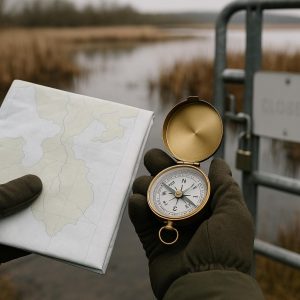
You're on a breezy coastal walk. The map is happily unfurled and your reading of it is not spoilt by any soakage of the paper whatsover. But a sudden, squall-like shower has appeared. You've got damp hands and your map and compass are getting salt-laden from the wind. So the case has to be a means of preserving your ability to navigate; it has to be a means of reading your map too. You don't want to have to put the map in a case and then open it up again. So you have to choose between a number of conflicting aims.
Start with the walk, not the product shelf
On average a day walker will set off from a car park, refer to a map at the start of their walk and thenre refer to it on a regular basis at junctiones, crossroads, stiles, etc. They may also refer to it to check if they are on a public right of way and to see if an alternative route round a flooded section is possible. In order to do this they need a map case that can be easily opened and closed.
If you are planning to open and shut your map case frequently on your short day walks, then a large expedition-style pouch is probably overkill. On the other hand, a very slim sleeve to stow your map may pack down sufficiently to slip into your back pack, but then your map will not be able to fold up around the area that you are currently exploring. Remember to take into account the size of the map that you will be using for the route that you plan to take.
Water resistance is not the same as waterproofing
The same terms are often used by map case manufacturers to describe their weather protection. Water-resistant generally refers to cases that can withstand occasional splashes of water, such as drizzle. A fully waterproof map case is designed with a waterproof seal and will have a more robust closure. So, don't rely on weather protection alone.
This is the opening and you should look for a simple design that does not contain any awkward closure mechanisms that will be difficult to open and shut when your fingers are cold and wet. Also look for edges that are not likely to get caught on your clothing or on your pack's straps. Once opened, look for the material used for the cover to be of a quality that will not get grit trapped in the seal. The material should also remain strong and not deteriorate with repeated use.
Make the map easy to read through the cover
The window of the case must also allow reading of the map. Very cloudy or even more negatively reflecting surfaces (such as normal synthetic surface) of the material can lead to hidden fine line work such as route details etc. – even in quite strong light. Under normal lighting conditions, folding of the map should also be possible while it is in the case.
Consider the reading of the map and how you would like to orientate it. Ensure that there is enough room to re-fold the map to a suitable size for the window. Check that using a compass in the case does not cause the map to be folded in such a way that it becomes difficult to read for other navigation purposes. Try reading the map in different angles of light to test for clarity.
Choose a size that supports real map handling
The case needs to be big enough for the map to be folded out in the viewing area but not so big that it is going to become excessive. A large pouch on an expedition might be sufficient for all of a walker's maps but for a short day walk a small sleeve would be far better. The size of the case will depend on the map size and how the map is going to be used.
Consider a typical morning at the start of your walk. You have parked your car at a suitable location, have checked the details of your intended route, and have set off along the path. You stop to view your map on several occasions – at junctions, at milestones, at access points to beaches or across rivers. Along exposed ridges and cliffs you may be checking your map frequently to identify your position and to locate suitable places to take shelter from the weather.
Carry it where you can reach it
Will it fit in your pocket? Does it attach to your neck, backpack, belt or in your pocket in a convenient manner? Will it stay put when you are bending, climbing stiles, or pushing through thick low vegetation? Once you have found a case that will keep your map dry, make sure it isn't going to be a nuisance when you are out and about.
In some circumstances, it is better to keep your map outside your main pack. If you decide to take it with you then fold up the necessary section of your map and open up the case viewing area. By placing your map in this section you can then fold up the rest of the map to avoid creasing it. Adjust the lanyard cord so that the map will sit comfortably on your person without getting snagged. Try to avoid dangling the map from your neck or off your pack as it could catch on several things such as, fences, branches, and other equipment.
You will typically use a transparent cover to read your map. This needs to be of sufficient quality to allow you to read your map well in all conditions but it should not be relied upon for complex navigation. Compare the map with the landscape on your route as you would normally and use your map to navigate as you would normally. Where visibility or the quality of the information about access to an area has deteriorated take with you the most up-to-date local access information and follow official safety guidance for that area.
Check the details that matter after a wet walk
Another small point but one that would be irritating on extended use is the case having rounded edges rather than being a hard square or even a flat rectangle. A lanyard attachment point should also be integrated into the case rather than being a thin loop added to the corner after thought. A removable insert or even a small internal pocket to stop the map folding unfolding could be added but would obviously add bulk to the case.
And, after the walk, when the cover and map have had a chance to dry out, shake out any sand and wipe off any salt residue with clean water where the manufacturer has told you to. Then turn the case inside out and inspect the closure and seams for any sign of weakness. Don't store a damp map folded up inside a case. In time it could stick together, crease or even start to deteriorate.
The choice should help make good navigation of the exposed path, the ordinary, a habit. It should keep your map sheet safe from weather, visible when needed, and easily to hand when strong wind gets in the way. That's about as much as you need. The rest is merely distraction from the great views of coast, of vulnerable plant and animal life, of sensitive ground, which you can enjoy provided you take responsible access to the country inland.